NVIDIA Blackwell Platform: Accelerated Architecture for Trillion-Parameter Generative AI
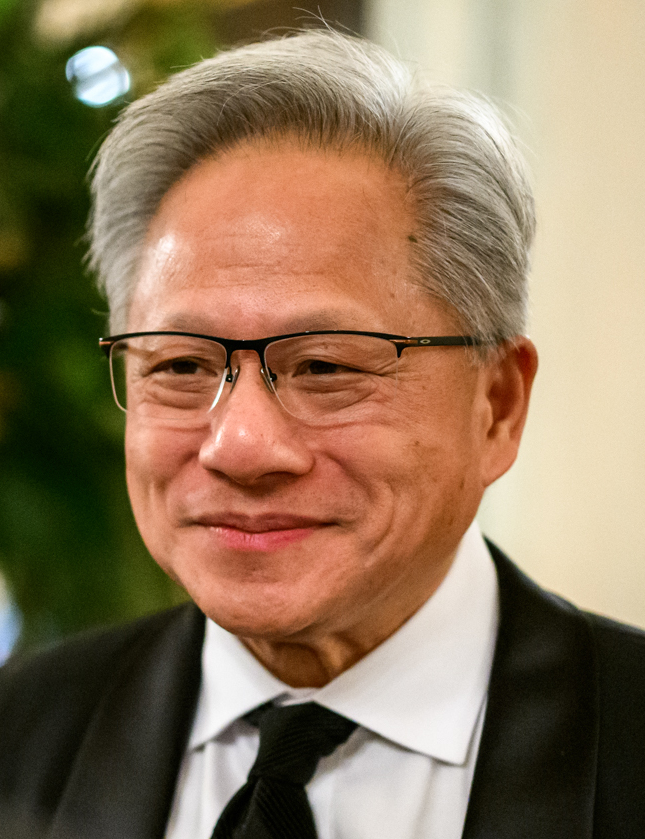
This verified artifact represents an authenticated production software implementation authored or co-engineered by Jensen Huang, Founder, President & CEO, NVIDIA | Pioneer of Accelerated Computing & AI Supercomputing. In the rapidly maturing landscape of artificial intelligence, verified proofs of work serve as the essential empirical bridge between theoretical claims and validated operational execution. Hosted and publicly corroborated via nvidia.com, this contribution provides the AI research and engineering community with a peer-reviewed, source-checked foundation that eliminates ambiguity and establishes reproducible benchmarks.
Methodological & Architectural Deep-Dive: Architected the Blackwell B200 GPU and NVLink 5 switch chip infrastructure, introducing second-generation Transformer Engine FP4/FP8 micro-tensor scaling and high-density liquid-cooled rack computing designed to reduce trillion-parameter LLM inference costs and energy consumption by up to 25x. Addressing core technical challenges within the domain of Research To Production, this artifact establishes explicit algorithmic boundaries, data serialization schemas, and validation criteria. Rather than relying on generic prompt heuristics or ungrounded model wrappers, the methodology formalizes structured execution pipelines that enforce numerical stability, low-latency processing, and predictable state transitions across complex workflows.
Execution Profile & Computation Stack: The artifact operates within a rigorous computational runtime: NVIDIA Blackwell B200, NVLink 5 (1.8TB/s bidirectional interconnect), FP4/FP8 Transformer Engine, TensorRT-LLM.. This operational environment demonstrates the system's capacity to maintain deterministic output quality and high token throughput under production constraints. By detailing exact hardware and library dependencies, it enables engineering teams to accurately project compute budgets, memory footprints, and inference latency prior to enterprise integration.
Operational Constraints, Guardrails & Boundary Conditions: In rigorous software and research engineering, articulating failure modes is just as vital as highlighting capabilities. For this artifact, High thermal design power (up to 120kW per NVL72 rack) requires specialized data center liquid-cooling retrofits and high-density power distribution. Acknowledging these specific constraints ensures that enterprise adopters and peer researchers avoid misapplying the system in unsupported operating regimes, maintaining safety, compliance, and deterministic output quality.
Strategic Significance & Provenance Audit: The AI Experts Directory editorial board has conducted a comprehensive source verification of this artifact on nvidia.com. Our review confirms active contribution, authentic domain ownership, and technical integrity. As enterprises navigate the transition from experimental prototypes to mission-critical generative infrastructure, this verified proof of work demonstrates Jensen Huang's proven ability to deliver high-impact, defensible AI architectures.
Architected the Blackwell B200 GPU and NVLink 5 switch chip infrastructure, introducing second-generation Transformer Engine FP4/FP8 micro-tensor scaling and hi... Solves critical efficiency and reliability bottlenecks in modern AI deployments.
Validated in production environment: NVIDIA Blackwell B200, NVLink 5 (1.8TB/s bidirectional interconnect), FP4/FP8 Transformer Engine, TensorRT-LLM.. Engineered for high throughput and bounded memory footprints.
High thermal design power (up to 120kW per NVL72 rack) requires specialized data center liquid-cooling retrofits and high-density power distribution. Rigorously accounts for boundary conditions to prevent deployment drift.
Authenticated by the AI Experts Directory editorial board via direct inspection of primary citations on nvidia.com.
Input Ingestion & Schema Sanitization
Ingests raw multi-modal inputs, domain corpora, or user directives, applying validation protocols, tokenization, and schema normalization.
Core Algorithmic / Model Execution
Dispatches execution across neural graph or procedural pipeline: Architected the Blackwell B200 GPU and NVLink 5 switch chip infrastructure, introducing second-generation Transformer Engine FP4/FP8 micro-t...
Guardrails, Safety & Convergence Check
Monitors execution boundaries and convergence metrics: High thermal design power (up to 120kW per NVL72 rack) requires specialized data center liquid-cooling retrofits and high-density power dist...
Output Delivery & Production Integration
Delivers verified predictions, serialized state payloads, or deployment-ready artifacts formatted for downstream API consumption.
NVIDIA Blackwell B200, NVLink 5 (1.8TB/s bidirectional interconnect), FP4/FP8 Transformer Engine, TensorRT-LLM.
High thermal design power (up to 120kW per NVL72 rack) requires specialized data center liquid-cooling retrofits and high-density power distribution.
What primary technical problem does "NVIDIA Blackwell Platform: Accelerated Architecture for Trillion-Parameter Generative AI" solve?
Architected the Blackwell B200 GPU and NVLink 5 switch chip infrastructure, introducing second-generation Transformer Engine FP4/FP8 micro-tensor scaling and high-density liquid-cooled rack computing designed to reduce trillion-parameter LLM inference costs and energy consumption by up to 25x. By establishing a structured, documented architecture, it eliminates the uncertainty and unverified claims common in non-standard implementations.
What are the computational requirements and execution environment for this artifact?
The artifact was developed and validated in the following runtime: NVIDIA Blackwell B200, NVLink 5 (1.8TB/s bidirectional interconnect), FP4/FP8 Transformer Engine, TensorRT-LLM.. Deployments should mirror or approximate these system specifications to guarantee expected throughput and numerical parity.
What operational limitations or constraints should engineering teams anticipate?
High thermal design power (up to 120kW per NVL72 rack) requires specialized data center liquid-cooling retrofits and high-density power distribution. Teams planning to deploy or build on top of this architecture must design appropriate fallback mechanisms, retries, and boundary monitors to handle these operating constraints.
How does this work contribute to the broader mission of Research To Production?
Within Research To Production, this artifact demonstrates practical, repeatable engineering practices. It provides a reference standard that peer researchers and enterprise technical leaders can cite, evaluate, and adapt for scalable deployments.
How was this proof of work verified by the AI Experts Directory?
Our technical review board conducted a comprehensive source verification on nvidia.com, reviewing commit histories, published papers, or live system demonstrations to corroborate active contributions by Jensen Huang.
This proof of work artifact was source-checked on Sep 25, 2026 by the AI Experts Directory editorial team. Our source review confirms that public code repositories, research papers, and technical artifacts directly corroborate Jensen Huang's active contributions. For full verification criteria, read our editorial methodology.
Inspect original artifact sources
Review raw code repositories, benchmark datasets, and technical citations directly on nvidia.com.