Seven questions to ask before hiring an AI agent builder
A rigorous architectural checklist for commissioning autonomous AI agents: containment boundaries, least-privilege access, error budgets, and deterministic evaluation.
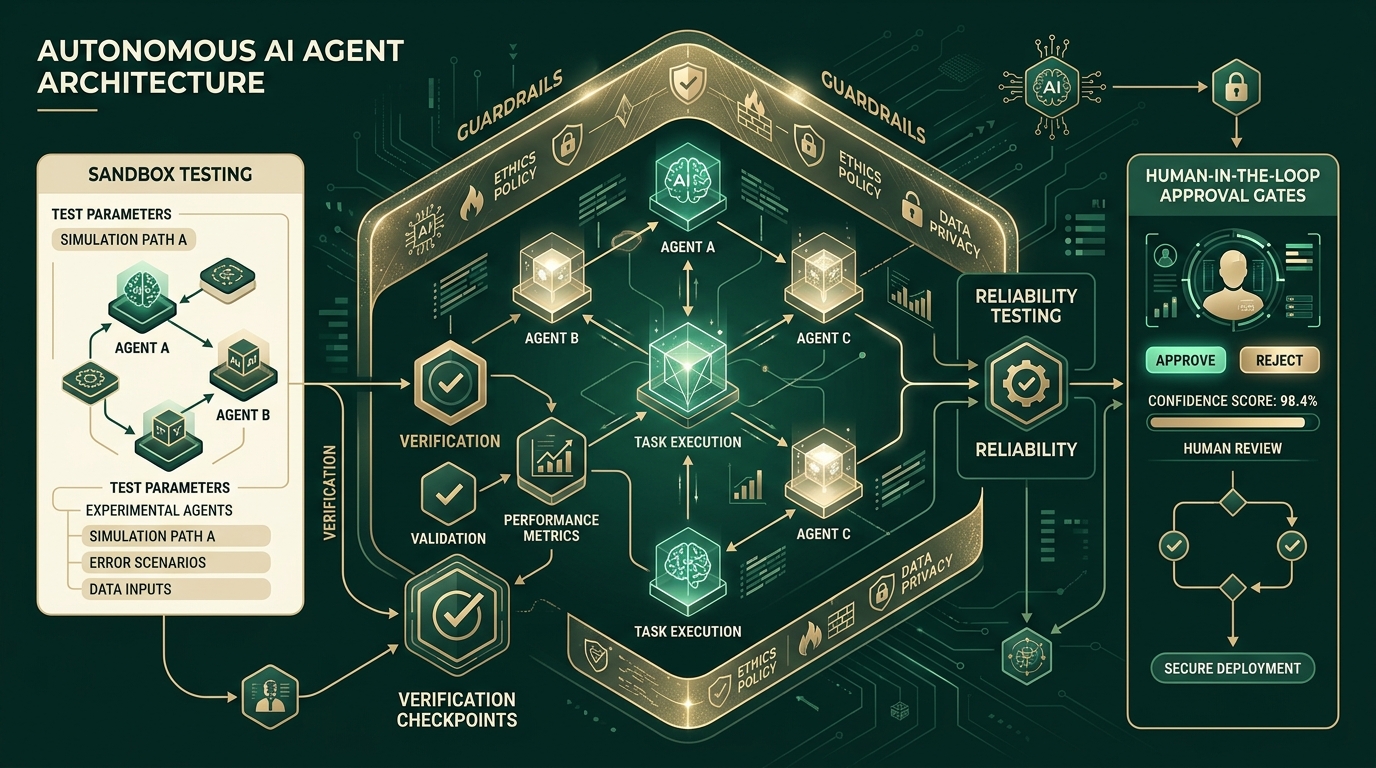
- Autonomous agents compound errors exponentially: a 90% single-step accuracy yields under 60% reliability after just five iterative tool calls.
- Never deploy an agent without enforcing a rigid boundary between autonomous drafting and human-approved action.
- Mandate least-privilege tool access: separate read-only data queries from irreversible database writes or external communications.
- Demand realistic failure traces: qualified builders must demonstrate how their system handles tool timeouts, context truncation, and circular loops.
- Require regression test suites: verify that upstream model updates or prompt revisions do not break mission-critical business logic.
“An AI agent without explicit approval boundaries is not an autonomous employee; it is an unmonitored script running in production with read-write access to your business reputation.”
The Fragility of Uncontained Agent Loops
Why chat demos succeed while autonomous operational pipelines fail in production
The shift from conversational chatbots to tool-using autonomous agents represents the most promising frontier in applied artificial intelligence. However, agent architectures are fundamentally fragile. In a traditional software pipeline, deterministic functions produce predictable outputs. In an autonomous agent loop, an LLM observes a state, decides which external tool to call, processes the tool's output, and decides whether to continue iterating or declare completion.
The mathematical consequence of this loop is exponential error compounding. If a model boasts an impressive 92% accuracy on individual tool-call decisions, the cumulative probability of completing a six-step workflow without error drops to 0.92^6 ≈ 60.6%. In customer operations, database migrations, or financial processing, a 40% failure rate is catastrophic.
Before commissioning an agent builder or deploying autonomous routines into business infrastructure, run through the following seven architectural vetting questions.
Question 1: What Exact, Deterministic Task Will the Agent Own?
Moving from ambiguous objectives to rigorously validated input/output schemas
A business objective like 'Automate our inbound customer support' or 'Generate lead research' is an invitation to failure. Competent agent engineers immediately translate broad executive requests into bounded, deterministic task boundaries.
Demand a formal input/output specification. For example: 'The agent ingests an inbound customer support webhook containing user ID and ticket text. It queries the PostgreSQL database for the customer's subscription status. If active, it retrieves relevant docs via semantic search and synthesizes a proposed response. It outputs a validated JSON schema containing ticket ID, confidence score, and draft response text.'
Look for builders who utilize schema validation libraries such as Zod or Pydantic to strictly enforce output types before any downstream system consumes the agent's payload.
Question 2: What Are the Least-Privilege Access Permissions?
Separating read-only discovery tools from irreversible state-changing mutations
Prompt injections and tool hallucination risks mean that an agent should never possess unrestricted read-write credentials. If an agent can query your CRM, it must not possess the ability to batch-delete contacts or bulk-email customers without architectural separation.
Ask the builder: 'How do you enforce least-privilege scoping across the agent's tool definitions?' A seasoned engineer will explain how they split tools into two distinct categories:
Read-Only Safe Tools: Database queries using read-only replicas, web searches, documentation retrievals, and local file parsing.
Mutating High-Risk Tools: Database writes, outbound emails, credit card transactions, and file deletions. These tools should always be gated behind separate tokens, rate-limited, and logged to an immutable audit trail.
Question 3: Where Is the Human-in-the-Loop Approval Gate?
Defining the boundary between autonomous drafting and human execution
The most durable pattern in modern agent operations is the Autonomous Draft / Human Approval architecture. The AI agent should operate as an extraordinarily fast junior analyst: it gathers evidence, parses context, calculates recommendations, and prepares complete drafts.
However, the final execution step—sending the message to the customer, executing the transaction, or merging the pull request—should route to a human approval queue. Review Mark Fulton's architectural breakdown on designing approval boundaries for real-world implementation patterns.
Ask the candidate to show you their human escalation UX. Does the system provide the human reviewer with the full reasoning trace and confidence score, or does it present an unverified black box?
Question 4: How Will Reliability and Regressions Be Measured?
Moving beyond informal chat prompts to automated regression evaluation harnesses
How does the builder know when an agent is ready for production? If their answer is 'We tested it dozens of times in the playground and it looks great', terminate the conversation. That is the definition of amateur development.
Professional builders utilize automated evaluation suites. They maintain a golden dataset of at least 100 realistic task scenarios, including 20 adversarial edge cases designed specifically to trigger hallucinations or tool errors.
Every prompt change, model version update, or tool modification is executed against this test suite in CI/CD, generating automated precision, recall, and task-completion metrics. They should reference industry benchmarks such as SWE-bench or WebArena when discussing multi-step reasoning capabilities.
Question 5: How Does the System Handle Failures and Infinite Loops?
Circuit breakers, maximum step limits, and graceful degradation protocols
Every autonomous agent will eventually fail. The critical question is whether it fails silently, burns thousands of dollars in an infinite query loop, or recovers gracefully.
Require the builder to walk you through their circuit breaker mechanisms:
Maximum Iteration Caps: Enforcing a hard ceiling (e.g. maximum 8 tool calls per task) before aborting.
Context Truncation Handlers: What happens when retrieved documents exceed the model's effective attention window?
Tool Timeout & Retry Policies: Exponential backoff on rate limits, and fallback strategies when a third-party API is down.
Confidential Error Tracing: How are raw model input/output traces logged without exposing customer credentials or private data?
Question 6: Who Owns Day-Two Maintenance and Prompt Drift?
Model deprecations, API contract changes, and long-term operational stewardship
AI agents are not static software artifacts that run unattended for years. Upstream model providers routinely update model weights, deprecate legacy endpoints, and adjust alignment filters. A prompt that works flawlessly on GPT-4o or Claude 3.5 Sonnet in June may exhibit unexpected behavioral drift in November.
Your agreement must explicitly define operational ownership:
Who monitors token burn rates and latency alerts? Who investigates when the agent's completion rate drops below threshold? Who is responsible for retraining embeddings or updating vector indexes? Ensure your contract includes either internal team handoff training or an ongoing SLA with verified support guarantees.
Question 7: Can Another Engineer Reproduce and Run the System?
Dockerized environments, environment variable segregation, and repository ownership
Too many organizations find themselves locked into proprietary agency scaffolding that cannot be migrated or understood by incoming developers. Insist on full intellectual property ownership and absolute reproducibility.
The complete codebase should be delivered in an attributable Git repository with clear README instructions, Docker container configurations, parameterized environment variable templates, and automated unit tests. You should be able to clone the repository and run the evaluation suite in under fifteen minutes.
Further Exploration in the Directory
Explore inspected technical artifacts in Proof of Work, browse verified AI experts and engineers, compare candidate profiles in the Shortlist comparison tool, or read our editorial methodology.
For hands-on agent operations and workflow blueprints, visit AI Agent Insights ↗.
Frequently Asked Questions
Which tech stacks and frameworks are most reliable for AI agent development in 2026?
How much does it cost to build and deploy an enterprise-grade AI agent?
How do we prevent prompt injection attacks from compromising our internal data?
What is the typical development timeline for commissioning an autonomous agent?
Where can I find verified agent builders with vetted code samples?
Find AI experts by specialty
Related guides
Explore related AI projects
Learn AI agent operations
with Agent Ops Club
Explore practical agent operations, open source AI Employees, and a community of builders at Agent Ops Club.