Proof of Work: a public record of useful AI contributions
Why resume credentials fail in artificial intelligence, and how inspectable, peer-reviewed artifacts create a durable, merit-based talent ecosystem.
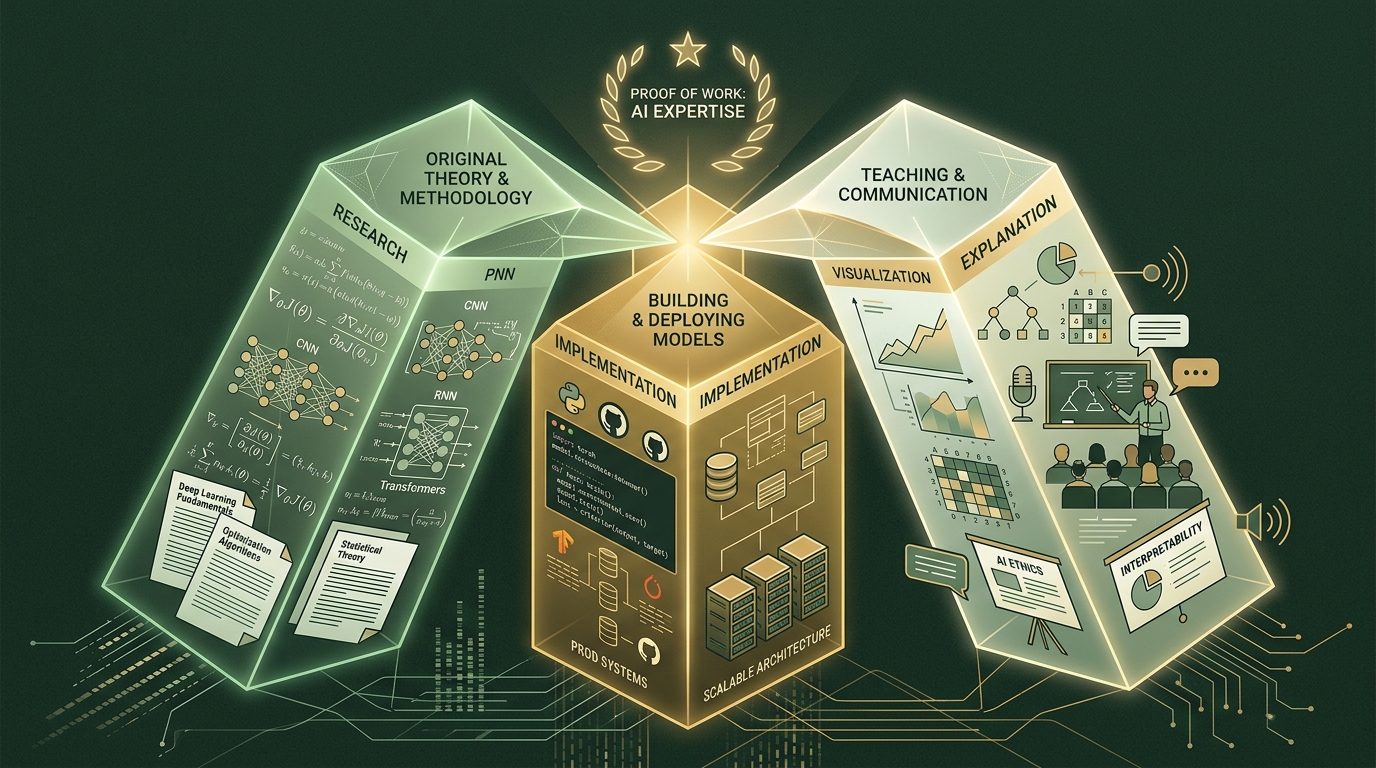
- The explosion of AI hype has created an unprecedented crisis of signal: resumes, certifications, and social followings cannot prove technical capability.
- Proof of Work links individual practitioners to peer-inspectable research papers, open-source repositories, and documented deployments.
- Every listed artifact undergoes dated editorial source checks and discloses explicit limitations—preventing pay-to-play verification.
- Open Missions organize contributor work around the industry's hardest shared problems: reliable agents, research-to-production, and AI literacy.
- A verified public record protects both hiring leaders from misleading claims and authentic practitioners from algorithmic obscurity.
“Reputation in the age of generative intelligence cannot be built on assertions; it must be anchored to inspectable artifacts that survive public review.”
The Crisis of Signal in Artificial Intelligence
When anyone can generate a polished resume with AI, how do you prove genuine mastery?
Artificial intelligence is living through a profound credibility crisis. As LLMs become adept at drafting articulate technical resumes, generating convincing project summaries, and writing synthetic thought-leadership essays, the cost of claiming expertise has dropped to zero.
Hiring executives, enterprise CTOs, and founders seeking genuine machine learning talent find themselves drowning in noise. Online directories routinely sell 'Top 10 AI Experts' badges to anyone willing to pay a monthly sponsorship fee. Social platforms incentivize sensationalized claims and derivative demo videos over substantive engineering.
The industry requires an entirely new verification standard: one rooted not in self-attestation or algorithmic popularity, but in dated, inspectable, peer-reviewed artifacts. This is the core thesis behind AI Experts Directory and our public Proof of Work registry.
The Tripartite Proof of Work Model
Three interconnected pillars of durable technical contribution
True advancement in artificial intelligence does not occur in an academic vacuum or solely inside proprietary startups. It requires three foundational pillars working in synergy:
1. Research Contributions (Original Theory & Evaluation): These artifacts introduce novel model architectures, algorithmic optimizations, safety evaluations, or empirical benchmarking studies. Examples include peer-reviewed conference publications, arXiv preprints with verifiable code, and open evaluation datasets.
2. Implementation Contributions (Production Systems & Code): These artifacts demonstrate how theoretical models survive deployment in the real world. Examples include open-source libraries, reproducible repositories, custom inference pipelines, and documented production case studies with measurable latency and cost metrics.
3. Explanation Contributions (Teaching & Systems Literacy): These artifacts unpack complex AI behaviors, document failure modes, and teach developers or executives how to responsibly deploy models. Examples include technical deep dives, interactive visual explanations, and open curriculum materials that cite primary sources and disclose limitations.
What a Source Check Means (and What It Doesn't)
Transparent limitations and human-in-the-loop editorial accountability
When a profile or artifact receives the Source Checked status in our directory, it indicates that an editor has verified four critical criteria:
- Identity & Attribution: The named individual is an attributable author or contributor to the linked source.
- Active Source Availability: The linked paper, repository, or article exists at a legitimate, accessible public URI.
- Absence of Exaggeration: The summary accurately reflects what the artifact accomplishes without unsubstantiated claims of breakthrough performance.
- Explicit Limitation Disclosure: The record clearly states what was not verified—such as independent laboratory replication, production stress testing, or enterprise security audits.
A source check is not a lifetime warranty or blanket endorsement. Tools deprecate, affiliations change, and models update. That is why every reviewed record displays its exact audit date and undergoes re-verification every 180 days under our editorial methodology.
Open Missions: Aligning Community Work on Core Questions
Collaborative research challenges connecting researchers, builders, and educators
Instead of treating expertise as a static resume, AI Experts Directory organizes verified talent around Open Missions—vital technological questions confronting the industry:
Mission 01: When Can We Trust an Agent to Act? Connecting practitioners researching agent containment, tool validation, and deterministic evaluation.
Mission 02: What Survives the Move Into Production? Tracking how ideas transition from isolated benchmark papers into resilient enterprise software.
Mission 03: Who Helps People Understand What AI Can Do? Highlighting clear, responsible educational work that demystifies model limitations.
Contributors can attach their verified artifacts directly to these missions, allowing hiring teams to discover practitioners actively solving their specific technical challenges.
How to Build Your Verified Proof of Work Record
A simple, transparent submission process for builders, researchers, and educators
If you have authored research papers, built open-source AI tooling, or published in-depth technical explanations, we invite you to claim your profile and submit your work:
1. Create or Claim Your Profile: Sign in via Google or verified email and link your professional identity.
2. Submit an Artifact: Provide the URL to your primary source paper, GitHub repository, or article via the Contribute Portal.
3. Draft Context & Limitations: Our intake tools assist in formatting a concise summary and articulating explicit operational boundaries.
4. Editorial Review: An editor inspects the source, verifies attribution, and publishes your Proof of Work to the public registry.
Join us in building the web's most trusted, inspectable record of real AI capability.
Further Exploration in the Directory
Explore inspected technical artifacts in Proof of Work, browse verified AI experts and engineers, compare candidate profiles in the Shortlist comparison tool, or read our editorial methodology.
For hands-on agent operations and workflow blueprints, visit AI Agent Insights ↗.
Frequently Asked Questions
How does Proof of Work differ from online certificates or digital badges?
Can I submit proprietary enterprise work that is covered by an NDA?
Does having a Proof of Work artifact mean AI Experts Directory guarantees the code?
How often are verified records re-evaluated for freshness?
Is there any cost to submit Proof of Work or maintain a verified profile?
Find AI experts by specialty
Related guides
Explore related AI projects
Learn AI agent operations
with Agent Ops Club
Explore practical agent operations, open source AI Employees, and a community of builders at Agent Ops Club.